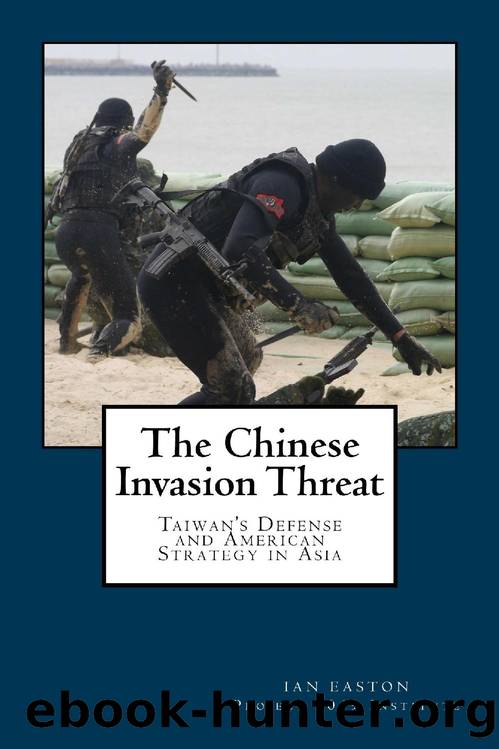
The Chinese Invasion Threat by Ian Easton
Author:Ian Easton [Easton, Ian]
Language: eng
Format: epub
Tags: Taiwan, China, invasion, war, cross-strait
Publisher: Eastbridge Books
Published: 2017-11-14T00:00:00+00:00
Phase One: Mobilization and Force Preservation
Publically available materials indicate that Taiwan’s war plan likely has three major phases of operations, each of which is specifically designed to counter the three main phases of the PLA’s Joint Island Attack Campaign. The first phase aims to prepare for PLA surprise attacks. Reservists would be mobilized to fortify the island, and high value assets bunkered down. The second phase of the plan envisions launching joint task forces out to engage and destroy Chinese amphibious fleets before they could strike. The last phase of the plan calls for surviving Taiwanese units to fight along the coast to repel invasion and defend the homeland. If necessary, homeland defense forces would fall back into the major population centers and mountains to fight a prolonged series of sieges and counterattacks.
Mobilization and force preservation begins once Taiwan’s government receives unambiguous warning of an impending attack. At this point, the president would confer with her cabinet and the leaders of parliament. She would then announce a state of emergency and declare a limited period of marital law.[424] Classified legal procedures have reportedly been drawn up to bring Taiwan’s latent strength alive and turn the government into a highly organized war machine. These secret procedures are reviewed, updated, and tested at least once every year to certify that the process, if necessary, could be carried out swiftly in very stressful circumstances. As soon as the president gave the order, Taiwan’s military could elevate readiness levels and go to a war footing.[425]
According to Taiwanese sources, force preservation in the invasion scenario would probably begin with the president, her cabinet and parliamentary leaders being moved to deep underground vaults, sealed into a system of secret command complexes that are capable of housing thousands of essential personnel under the earth’s surface. They might also disperse to safe houses and hide sites. Surrounding them would be a layered phalanx of ROC marines, military police, and special service bodyguards, entrusted with their protection. It seems probable that certain key decision makers would avoid meeting in person to ensure that the entire government could not be knocked out by a single sinister blow.[426]
Fleets of armored fighting vehicles and bullet-proof sedans housed in locations around Taipei are assigned the mission of moving selected personnel from place to place. Special tunnel systems are also thought to exist for moving them across the capital unseen. In wartime, bunkers and mobility operations are often the first lines of defense. Decoys and other deception measures would be instituted to confuse enemy agents. Individuals of interest, routinely monitored but left free to go about their business, would be rounded up in counterintelligence dragnets and put under lock and key. In some cases, known Chinese agents could be fed false information, used as pawns in high stakes deception operations.
With the top leaders secured, the priority order of business would be to call up the reserves. Taiwan maintains one of the largest and most sophisticated reserve systems in the world, allowing the military in
Download
This site does not store any files on its server. We only index and link to content provided by other sites. Please contact the content providers to delete copyright contents if any and email us, we'll remove relevant links or contents immediately.
| Africa | Americas |
| Arctic & Antarctica | Asia |
| Australia & Oceania | Europe |
| Middle East | Russia |
| United States | World |
| Ancient Civilizations | Military |
| Historical Study & Educational Resources |
The Dawn of Everything by David Graeber & David Wengrow(1708)
The Bomber Mafia by Malcolm Gladwell(1625)
Facing the Mountain by Daniel James Brown(1556)
Submerged Prehistory by Benjamin Jonathan; & Clive Bonsall & Catriona Pickard & Anders Fischer(1457)
Wandering in Strange Lands by Morgan Jerkins(1430)
Tip Top by Bill James(1417)
Driving While Brown: Sheriff Joe Arpaio Versus the Latino Resistance by Terry Greene Sterling & Jude Joffe-Block(1377)
Red Roulette : An Insider's Story of Wealth, Power, Corruption, and Vengeance in Today's China (9781982156176) by Shum Desmond(1359)
Evil Geniuses: The Unmaking of America: A Recent History by Kurt Andersen(1354)
The Way of Fire and Ice: The Living Tradition of Norse Paganism by Ryan Smith(1338)
American Kompromat by Craig Unger(1320)
F*cking History by The Captain(1305)
It Was All a Lie by Stuart Stevens;(1301)
American Dreams by Unknown(1288)
Treasure Islands: Tax Havens and the Men who Stole the World by Nicholas Shaxson(1274)
Evil Geniuses by Kurt Andersen(1257)
White House Inc. by Dan Alexander(1212)
The First Conspiracy by Brad Meltzer & Josh Mensch(1174)
The Fifteen Biggest Lies about the Economy: And Everything Else the Right Doesn't Want You to Know about Taxes, Jobs, and Corporate America by Joshua Holland(1126)
